In this guide
- Name the kind of completion
- Match the statement to its evidence
- Preserve remaining action
- Distinguish explanation from reopening
- Check the audience’s usable result
- Keep personal information out of the summary
- Learn from the ending without inventing a cause
- Use a four-part closing note
- Read next
- Sources and limits
A service loop is closed when the relevant work state is recorded and the person who needs the result can understand what it means. A system label alone may not do both jobs. “Closed” can describe an administrative event without explaining whether the original need was resolved, redirected or left with a further action.
Phoenix’s public service resources distinguish reporting, case status and information. Its performance-reporting context also reminds readers that counts and outcomes are different objects. This article offers an editorial method for reading and explaining completion; it does not define official Phoenix closure codes or inspect a live case.
Name the kind of completion
Begin by identifying what has actually ended. A contact may have ended, a request may have been routed, a review may have been recorded or work may have been performed. Each can be a legitimate endpoint for one part of a service. None should be silently substituted for the whole result.
For a worker, this distinction supports accurate communication within the authority of the role. For a reader, it supports a better follow-up question. Instead of assuming that a label is wrong, ask what state the label represents and whether another step remains.
Match the statement to its evidence
A completion statement should point to the appropriate approved record or official communication. Do not add certainty that the source does not provide. “The request was forwarded” and “the receiving function accepted it” are different claims. The handoff guide explains that difference in detail.
In a fictional example, a resident’s information question is answered with a link to the correct official resource. The information interaction may be complete even though the resident still needs to submit a separate request. A clear closing explanation says both things. It does not claim that the later request has already been made or approved.
Preserve remaining action
When something remains to be done, identify the action, its responsible party and the official place to find instructions. Avoid placing an obligation on someone merely because they were copied on a message. Responsibility comes from the actual process, not an editor’s preferred diagram.
If the next action is unknown, say so. A short unresolved question is more useful than a falsely reassuring sentence. The goal is not to force every interaction into a neat ending; it is to make the current state understandable enough that the next person can act appropriately.
Distinguish explanation from reopening
A reader may need an explanation of a closed status without needing a new request. Conversely, a changed condition may call for a different official action. The responsible service’s instructions determine what to do. This publication cannot reopen cases, transmit reports or decide whether a previous action was adequate.
Repeated submissions can complicate the record if they create multiple references for the same issue. Use the official follow-up route when one is provided. Do not interpret silence from this independent publication as a City response; the publication is not part of the service process.
Check the audience’s usable result
A technically accurate message can still be difficult to use. Does the reader know what happened, what remains and where to go next? Does the language distinguish a completed step from an approval? Does it avoid unexplained abbreviations or internal labels?
Usability does not mean promising a favorable outcome. A refusal, referral or request for more information can be explained clearly without changing the underlying decision. The person communicating it should stay within approved wording and authority, especially where formal rights or obligations are involved.
Keep personal information out of the summary
A broad service explanation usually does not require the names of employees, private resident details or copied documents. Use the authorized record for necessary case information. For training or public discussion, use a clearly labeled fictional example instead of disguising a real person’s record.
If you are sending an editorial correction to this website, include the article address and a public source. Do not send a case file. The contact page is for publication matters and cannot supply case-specific advice or official support.
Learn from the ending without inventing a cause
A completed interaction may reveal a recurring point of confusion: unclear instructions, an ambiguous status or a missing handoff acknowledgment. That observation can support a question for the authorized service owner. It does not establish why the problem occurred or who caused it.
For a small training review, record the misunderstood term, the clarification that helped and the boundary that must remain. Do not turn a single story into a claim about the entire department. Public performance conclusions need an appropriate dataset and definition, not only a memorable anecdote.
Use a four-part closing note
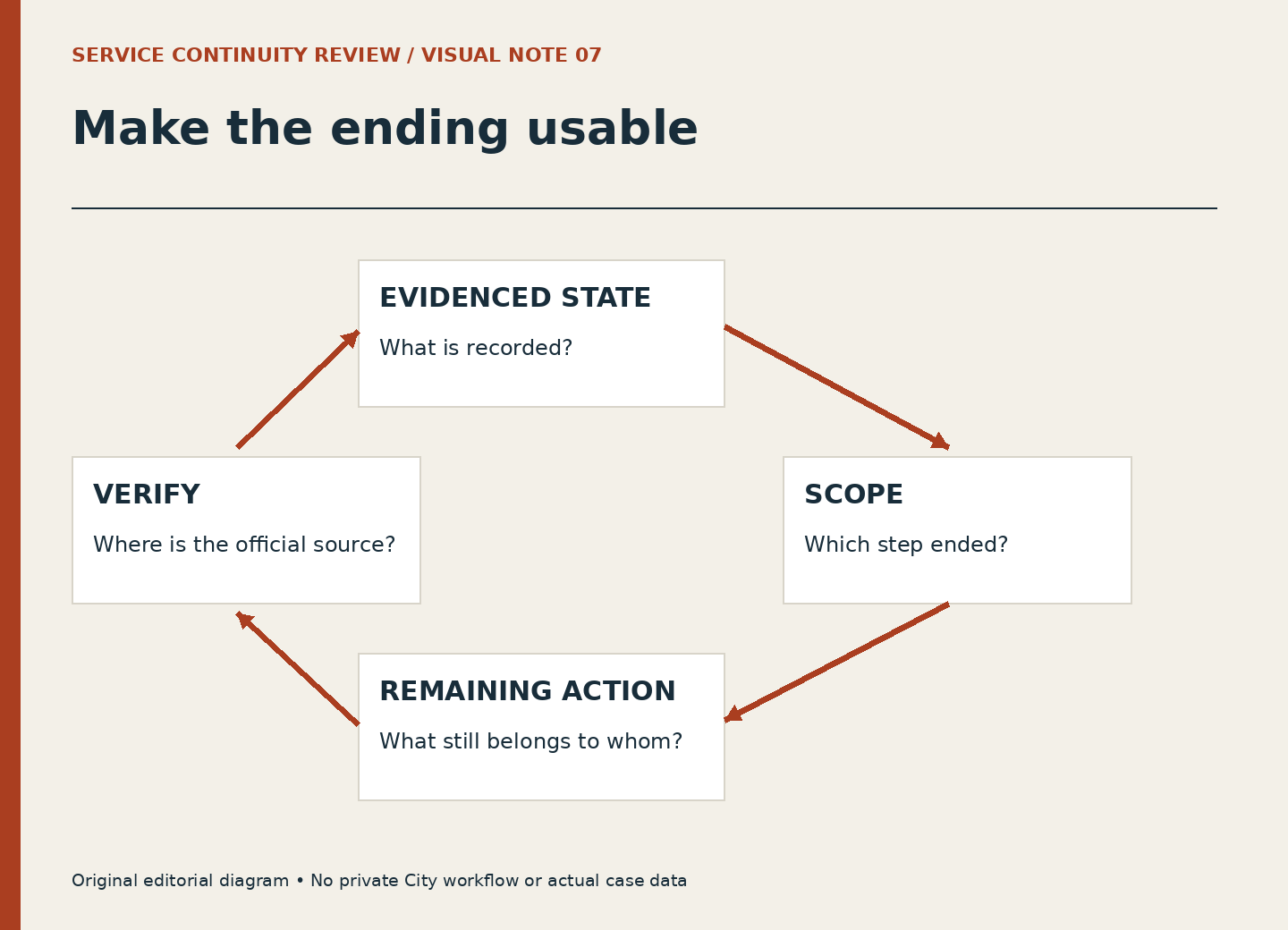
The note has four parts: the evidenced state, the scope of that state, any remaining authorized action and the place to verify it. It can be brief. A fictional version might read: “The information question has been answered. No application has been submitted through this interaction. Follow the current official submission instructions if you choose to proceed.”
That note does not hide uncertainty or create a promise. It tells the next reader where the service chain stands. For workforce readers, this is a practical way to value documentation and explanation alongside the visible task: continuity includes making the result usable.
Read next
- Prepare a Phoenix Workforce Question the Right Office Can Answer
- Read the PHX ACT Announcement as an Employee Reporting Map
- A Service Question and a Records Request Have Different Jobs
Sources and limits
Public sources checked October 5, 2026. Editorial examples are hypothetical; official instructions and case-specific decisions remain with the responsible City service.
- City of Phoenix: myPHX311
Public service categories and issue-reporting entry points. Not an emergency dispatch or employee HR interface.
- City of Phoenix: Neighborhood Services FAQ
Public routing distinguishes case status, neighborhood resources and service reporting. No individual case inspected.
- City of Phoenix: City Manager’s Performance Dashboard
Public performance-reporting context. This article does not reproduce or audit live dashboard values.